
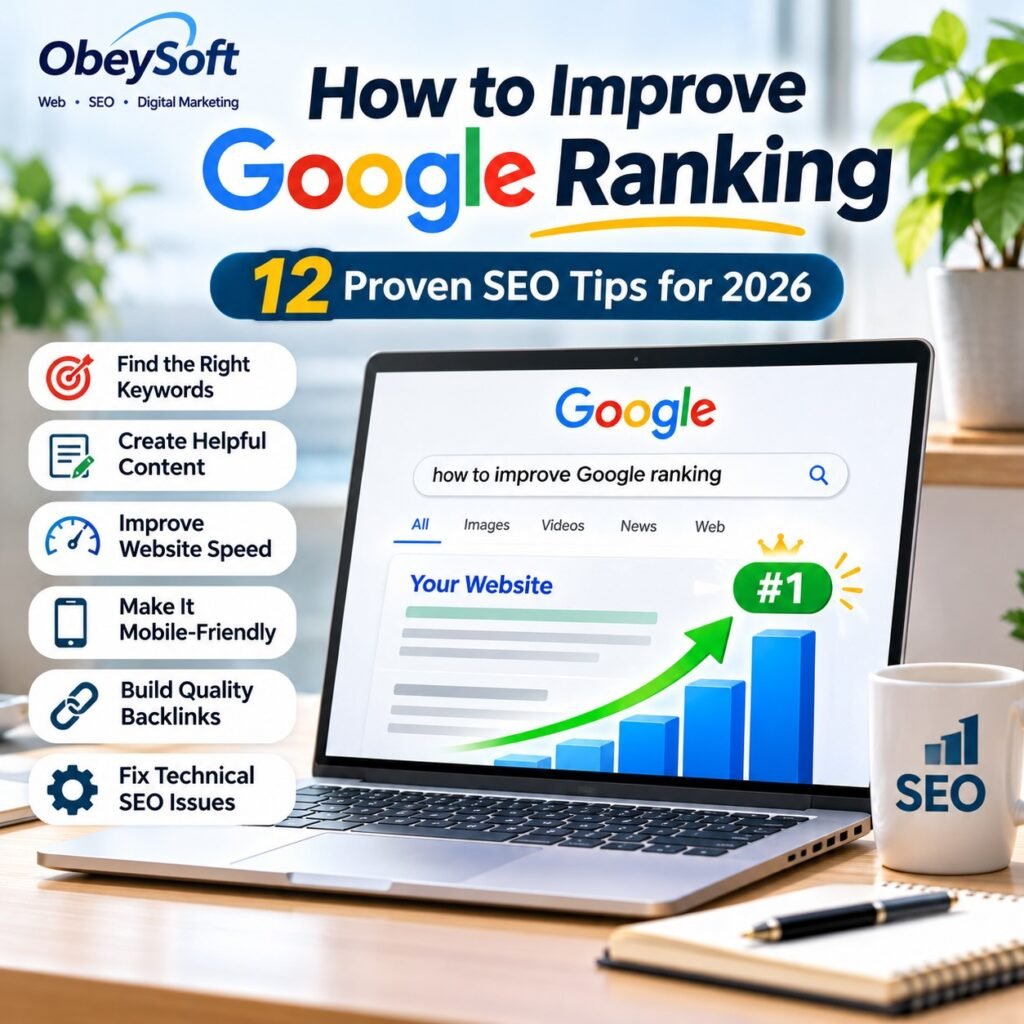
10 SEO Tips for Marketing and Digital Content Managers
 10 SEO Tips for Marketing and Digital Content Managers in 2026
Search engine optimization (SEO) is an essential part of building a successful digital marketing strategy. For marketing and digital content managers, effective SEO means more than choosing the right keywords. It involves understanding search intent, creating useful content, improving website performance, and measuring organic search results.
In 2026, digital marketing teams also need to consider how people discover information through Google AI Overviews, ChatGPT Search, Gemini, Perplexity, and other AI-powered search experiences.
At ObeySoft, we help businesses understand SEO, Answer Engine Optimization (AEO), and Generative Engine Optimization (GEO) strategies that support online discoverability.
Here are 10 practical SEO tips to help marketing and digital content managers improve their content strategy and website performance.
1. Understand Your Target Audience and Search Intent
Successful SEO begins with understanding what your audience wants to accomplish.
Before creating content, identify whether users are looking for information, comparing solutions, researching a brand, or preparing to purchase a product or service.
Actionable SEO tip: Group keywords by informational, commercial, navigational, and transactional intent. Create content that directly addresses each audience’s needs.
2. Perform Strategic Keyword Research
Keyword research helps marketing managers discover the words and questions potential customers use when searching online.
Use tools such as Google Search Console, Google Keyword Planner, Ahrefs, or Semrush to explore relevant topics, keyword variations, and search opportunities.
Prioritize keyword relevance, search intent, and the likelihood that your content can satisfy the query.
Actionable SEO tip: Assign a primary topic to each important page and support it with natural semantic keyword variations.
3. Create Helpful, Original, High-Quality Content
Google’s search guidance encourages content designed primarily to benefit people rather than manipulate rankings.
Develop articles that answer real questions, explain complex topics clearly, and offer useful examples or original insights.
Avoid publishing multiple nearly identical articles simply to target small keyword variations.
Actionable SEO tip: Before publishing, ask whether your content provides information that readers could not easily find in a generic summary.
4. Optimize Title Tags, Meta Descriptions and Headings
Well-written page titles help search engines and users understand what a page covers.
Use descriptive H1, H2, and H3 headings to organize the information logically.
Meta descriptions should summarize the page accurately and encourage relevant users to click. Google may generate a different search snippet depending on the query.
Actionable SEO tip: Include your primary keyword naturally in the page title and opening content where relevant, without excessive repetition.
5. Improve Website Speed and Mobile Experience
Website performance affects visitors’ experiences and can influence search performance.
Review loading speed, mobile usability, layout stability, and Core Web Vitals.
Pay attention to Largest Contentful Paint (LCP), Interaction to Next Paint (INP), and Cumulative Layout Shift (CLS).
Actionable SEO tip: Compress oversized images, reduce unnecessary scripts, optimize caching, and check important pages using PageSpeed Insights.
6. Strengthen Internal Linking and Website Structure
Internal links help visitors find related information and help search engines discover important pages.
Organize your website into logical categories and connect related articles, products, and services using descriptive anchor text.
For example, an article about keyword research might link to a technical SEO guide or a relevant SEO service page.
Actionable SEO tip: Review older articles regularly and add useful links to newly published content.
7. Build Trust Through Relevant Backlinks and Digital PR
Backlinks from credible, relevant websites can contribute to a strong online presence.
Instead of purchasing manipulative links, focus on publishing useful resources, contributing meaningful industry insights, and building genuine relationships with publishers.
Digital PR, original research, and relevant editorial coverage can also help introduce your brand to new audiences.
Actionable SEO tip: Evaluate backlink opportunities based on relevance, audience quality, and editorial credibility rather than third-party authority scores alone.
8. Optimize Content for AI Search, AEO and GEO
Modern audiences increasingly use AI-powered tools to research products, services, and business information.
Answer Engine Optimization (AEO) emphasizes clear responses to real user questions.
Generative Engine Optimization (GEO) focuses on improving the clarity, usefulness, credibility, and accessibility of information for AI-powered search environments.
These approaches build on established SEO principles rather than replacing them.
Actionable SEO tip: Include accurate definitions, concise answers, meaningful headings, original insights, and verifiable supporting information where appropriate.
No optimization technique guarantees citations or placement in AI-generated answers.
9. Use Structured Data Where Appropriate
Structured data provides machine-readable information about eligible page content.
Depending on the website and content type, relevant structured data may include Article, Organization, BreadcrumbList, Product, or other supported schema types.
Structured data should accurately describe visible content and comply with search engine requirements.
Actionable SEO tip: Use Google’s Rich Results Test and review structured data errors in Google Search Console. Avoid adding unsupported or misleading schema markup.
10. Measure SEO Performance and Update Content Regularly
SEO requires ongoing analysis and improvement.
Google Search Console can help you understand search impressions, clicks, click-through rates, indexing status, and queries generating traffic.
Analytics tools can help evaluate how visitors engage with your website and complete meaningful actions.
Instead of updating articles only to change their publication dates, revise content when you can add useful information, correct inaccuracies, or improve the reader’s experience.
Actionable SEO tip: Review important content periodically, monitor relevant search queries, and prioritize improvements based on performance and business objectives.
Bonus: Combine SEO, Content Marketing, AEO and GEO
An effective digital marketing strategy connects organic search optimization with audience research, content quality, brand credibility, and conversion goals.
For marketing and digital content managers, the goal should be to develop a coordinated content strategy that answers customer questions and makes important information easier to discover.
Traditional SEO helps improve website accessibility and search relevance. AEO encourages direct answers, while GEO emphasizes clear and credible information in AI-driven discovery.
Together, these practices can support a stronger digital presence without relying on unrealistic ranking promises.
Final Thoughts
These 10 SEO tips provide a practical framework for managing digital content and improving organic search performance.
Focus on understanding your audience, publishing genuinely helpful content, maintaining a technically accessible website, developing trustworthy online references, and measuring business outcomes.
SEO is a long-term process, and results depend on factors including competition, website history, content quality, and implementation.
Need Professional SEO, AEO or GEO Support?
At ObeySoft, we provide technical SEO, website optimization, content SEO, AEO, and GEO services for businesses seeking to strengthen their online visibility.
