WordPress vs Magento: Which is Better for eCommerce Development?
Every eCommerce business has its own unique requirements, and choosing the right platform plays a crucial role in success. Whether you want to convert your existing website into an online store or build one from scratch, selecting the right CMS is essential. Among the most popular options, WordPress and Magento stand out as powerful solutions—each with its own strengths.
Let’s explore a clear, SEO-friendly comparison to help you decide the best platform for your eCommerce website.
Why Choose Magento for eCommerce Development?
Magento is a dedicated eCommerce platform known for its robustness, scalability, and advanced features.
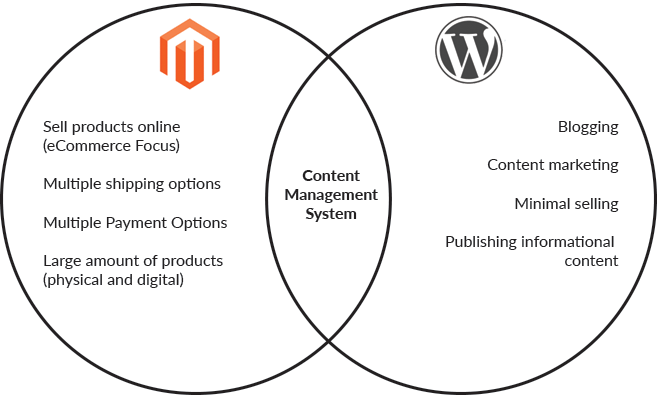
- Built for eCommerce: Magento comes with inbuilt features like product management, payment gateways, invoices, and shipping options.
- Highly Scalable: Ideal for medium to large businesses with growing product catalogs.
- Advanced Customization: Offers deep customization options for complex business needs.
- SEO-Friendly: When optimized properly, Magento websites can rank very well on search engines.
- Rich Features: Multi-store management, analytics, mobile commerce, and marketing tools.
- Better User Experience: Features like product comparison, filtering, wishlists, and customer accounts enhance usability.
However, Magento requires technical expertise and higher initial investment, making it more suitable for businesses with bigger budgets and long-term goals.
Why Choose WordPress for eCommerce Development?
WordPress, combined with plugins like WooCommerce, is a flexible and beginner-friendly platform.
- Easy to Use: Simple installation and user-friendly interface.
- Affordable Setup: Lower development cost compared to Magento.
- Huge Plugin Ecosystem: Thousands of plugins for payment gateways, SEO, and design.
- Flexible Website Types: Ideal for blogs, business sites, and small-to-medium eCommerce stores.
- Quick Launch: You can get your store live in less time.
However, WordPress relies heavily on plugins, which can:
- Increase security risks
- Slow down website performance
- Limit scalability for large eCommerce operations
Key Differences: WordPress vs Magento
| Feature | WordPress (WooCommerce) | Magento |
|---|---|---|
| Ease of Use | Beginner-friendly | Complex |
| Cost | Low to Medium | Medium to High |
| Scalability | Limited | High |
| Security | Moderate (plugin-based) | Strong |
| Customization | High (via plugins) | Very High (core-level) |
| Best For | Small–Medium stores | Medium–Large enterprises |
Which Platform Should You Choose?
- Choose WordPress if:
- You want a quick, affordable eCommerce setup
- Your store is small or medium-sized
- You focus heavily on content marketing
- Choose Magento if:
- You need a scalable and powerful eCommerce platform
- You have a large product catalog
- You want advanced customization and enterprise-level features
FAQs
1. Which is better for SEO: WordPress or Magento?
Both platforms are SEO-friendly. WordPress is easier to optimize using plugins, while Magento offers advanced SEO capabilities with proper technical setup.
2. Is Magento better than WordPress for large eCommerce websites?
Yes, Magento is more suitable for large-scale eCommerce websites due to its scalability and built-in advanced features.
3. Can I use WordPress for eCommerce?
Yes, with plugins like WooCommerce, WordPress can be used to create fully functional online stores.
4. Is WordPress secure for eCommerce websites?
WordPress can be secure, but it depends on proper plugin management, updates, and security practices.
5. Which platform is more cost-effective?
WordPress is more cost-effective for small businesses, while Magento requires a higher investment but offers better scalability for growing businesses.